
Holding onto stories
A reflection on processing my experiences in residency

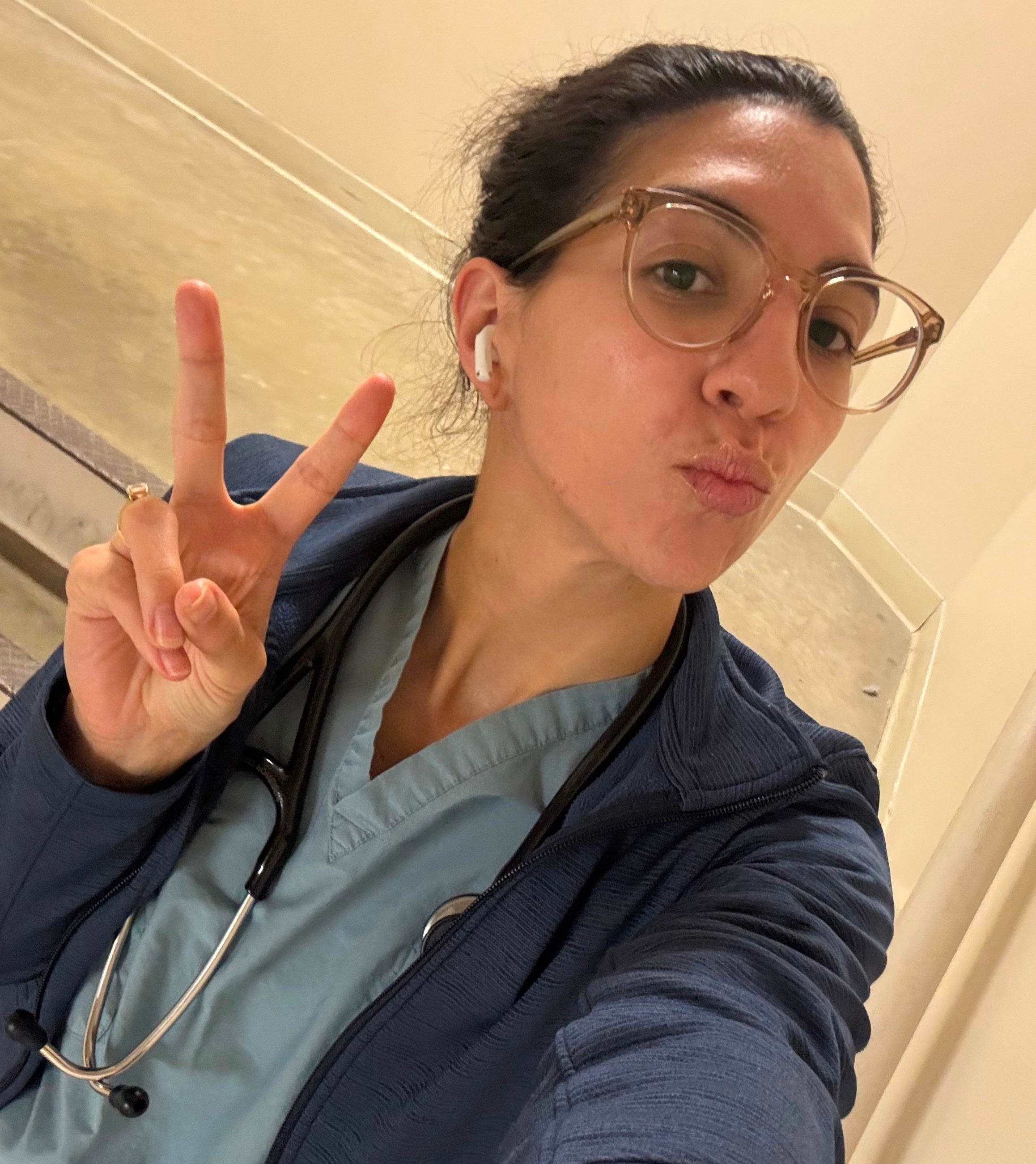
No mirror selfie this week. I took this photo in the stairwell at 4:22 am on a night shift in September and sent it to my fiancé. I was heading down to the ED to see a patient who I was admitting to the hospital. I was working a 2 week overnight stretch on the hematology-oncology service. Usually by this part of the night, I was losing my mind a bit.
I remember coming into medical school thinking that I’d be so excited to talk about everything I experienced. This was largely true during the first two years, which were pre-clinical, focusing on classroom work. Once I started my clinical rotations though, I pretty quickly had no desire to share much about my day. This aversion hasn’t changed much in residency either. Today, I consider why that is.
As a 3rd year medical student, and still as a resident, I witnessed some incredible and devastating things. As a student, I watched an emergency surgery in a patient experiencing a life threatening condition called acute mesenteric ischemia. This is essentially a lack of blood flow to the bowels that can cause really poor outcomes like loss of bowel and even death. This is one of those classic topics in medical school that students learn to identify based on the history and physical exam findings, lab markers, and imaging. In this case, there were a lot of factors behind the scenes that made this particular case pretty hard to witness, including delays in getting the patient to the OR for reasons I won’t get into here.
Before medical school, I thought this would be something I’d be racing to tell people about. In the moment though, I had almost no desire to talk about what I saw. It didn’t really matter if it was something awe-inspiring, depressing, or somewhere in the middle, I just didn’t want to talk about things. Even still, I’ll be on the phone with my mom and she’ll ask me to tell her about my day. Good day or bad day, I just can’t get myself to dive into the details. “It was fine” is all I can usually say.
I think a lot of it has to do with fatigue. At the end of these shifts, I am exhausted. Most of the time, I have just a few hours to get home, eat dinner, maaaybe drag myself to the gym (on a good day), and then I have to go to bed so I can get some sleep before having to go back the next day. The last thing I want to do with these few precious hours is re-live the things I just experienced and will likely see again tomorrow.
In a lot of ways, I feel a sense of guilt about this. In college, I took an incredible medical humanities class where we talked a lot about the role of physicians in bearing witness to the suffering patients experience. This role in bearing witness and then processing these stories is important. At the same time though, unpacking the details of these stories and reflecting on their weight and impact takes a lot of work and energy, and honestly, as a trainee, it’s a commitment that I can’t fully engage in all the time. That’s not to say that I don’t process these experiences, because I do, though probably not to the extent that I will ultimately need to do one day. But for now, processing the things I see, like everything else in my life during residency, is done in an efficient way.
Earlier this year in the fall, I lost two patients. Both were very sick and so their deaths weren’t unexpected, but how quickly they went from chronically sick yet still having time to needing to go to the ICU and ultimately passing was quicker than I had expected. I took both of these deaths pretty hard. I had rotated off service before they both ultimately passed, but in residency, we often follow patients who we take care of so we can see how they do. I remember seeing the death note from one of these patients. I was in clinic when I saw the death note. I had to keep it together because not 15 minutes later, I had a patient to see. When I finally got home, I sat on the couch, and immediately reached out to my senior who helped take care of this patient. I needed to just connect with someone else who knew this patient to acknowledge this loss with me. We discussed the case briefly, acknowledged the fact that she was very sick and my senior gave me some really kind words of validation that did lessen the guilt I felt, at least a little.
The line between accountability and “god-complex” is a weird thing in medicine. We joke about it sometimes, especially as it relates to certain specialties. But I think in some ways, many of us in medicine live with this tension nearly every day. On day 1 as an intern, I immediately felt responsible for the outcomes of my patients, both big and small. My first rotation was on the cardiology service (my fav!). On that service, we have a lot of patients with heart failure who come in with what we call acute decompensations, which really just means they have too much fluid and it makes it harder for their hearts to pump effectively. So we offload that fluid with medications called “diuretics” (water pills) Essentially, we bring them into the hospital and make them pee A LOT and try to adjust their home medications to make sure they are on the right regimen for their hearts. It can take some time figuring out these regimens and finding the right doses. We set certain goals each day for how much we want them to pee. It’s become pretty routine for me by now, but during that first month I felt so stressed about finding the right regimen. Mf my patient peed 1.5 liters but my goal was 2 liters, I felt horrible. Looking back I laugh at this but in the moment, that responsibility felt immense!
That is a more trivial example of the weight of responsibility that sits on our shoulders as residents. Obviously, there are heavier things too. Any time I have a patient go to the ICU, even still, I feel guilty. So far (knock on wood), none of my patients have gone to the ICU because of a mistake or error on my part but that’s not the reason for the guilt. The guilt lies in the feeling of wanting to do right by a patient, caring about what happens and wanting to help them get better. Unfortunately, it’s a reality in the hospital that we care for sick people, and sometimes sick people get sicker. Sending someone to the ICU is not a sign of a bad doctor, but a sign of a sick patient who needs a higher level of care with more monitoring, more attention from nursing, and oftentimes, medications or interventions that are not available on a general medicine floor.
Feeling guilty for not being able to stop a sick patient from getting sicker is an example of falling closer to the “god-complex” part of that spectrum. I remember telling my brother about that patient who ultimately passed away and sharing how guilty I felt. My brother, a lawyer, was supportive, but something he said still sticks with me. “How arrogant to think that you could have stopped this”. He wasn’t being mean, he was trying to demonstrate how dangerous that line of thinking can be. As doctors, we do everything we can to help our patients, and sometimes it just isn’t enough. And it’s not a fault of our own. Medicine has limits and even the best among us can’t make people live forever. Sometimes sick people will get sicker, despite our best efforts.
This is a really hard lesson to learn in training. In part because being an intern is a lot like being a toddler. You just have no context for a lot of what you’re seeing. As a toddler, you’d fall asleep in the car and then wake up like 2 hours later in your bed, and just have no idea where you are and how you got there. Or you’d be 5 years old seeing fireworks for the first time, and it’s just like “what the hell is this? Is this normal? Why is no one reacting to these bombs going off?” That’s a lot of what residency is. You’re thrown into a new situation and you have to learn on the fly what is normal, what is abnormal, and what to do about it.
People say the goal of intern year is to learn to identify “sick” vs “not sick”. If you can do just that, you’re doing great. It sounds simple and I do think I’ve started to develop an instinct for it, but it’s not always easy. A lot of learning the practice of medicine lies in the nuance. Things can be subtle. But in facing new situations almost daily, it’s hard to tease apart what happens as a result of your actions or inactions, and what just happens because it’s part of the natural course of a disease, or because that patient just happened to experience that thing. But, at least for me, inherent to trying to build a framework for identifying sick and escalating care, is the assumption that I am capable of recognizing these problems and intervening. The harder lesson to learn is that sometimes, it just isn’t enough.
Thinking through these lessons, it’s easy to see why at the end of a day, I don’t much feel like sharing. Sometimes it’s because I am still trying to make sense of that day’s events, sometimes it’s because I feel immense joy, guilt, or fear about something a patient is experiencing. Sometimes, it’s because nothing interesting at all happened (though admittedly, that is quite rare when on an inpatient rotation), and sometimes, it’s because after working 12-15 hours in a day, I want to spend the last few hours of my night turning my brain off before walking back into the chaos tomorrow.
My patients deserve a physician who cares for them and takes the time to share in the joy, grief, and fear that occurs within the walls of the hospital and reflects on these experiences. God knows I would want that for my loved ones or for myself. But I’d also want a physician who takes time for themselves, to process, recharge, and recover so that when they come back to work the next day, they are clear headed and ready to face whatever new challenges that day brings. It’s a hard balance to find, but ultimately, as I think you’ll see as I write more about my experiences during residency, just about everything in medicine is about finding a balance between two extremes. I think it takes a lifetime in this career to find it, and even then, I’m not sure everyone does.
At the end of the day, in finding this balance for myself, I’ll continue to hold on to the stories of the people I care for. I’ll find time to process these experiences whether it’s on the drive home, while at the gym on a day off, or in those rare times when I have the energy to talk about it with my support system. Each patient has taught me something and even on my hardest days, I’m grateful for the opportunity to care for them and to carry the lessons they taught me forward to the next patient I see.
- - - -
Hello from the middle of week 6 of an 8 week stretch. I’m over the hump, but somehow these last 2 weeks feel like they might be the hardest of the bunch. Nevertheless, one 5:20 am alarm at a time, I’m getting through it and learning a lot (or at least I hope I am). We’re past the daylight saving time switch, so the daylight lasts longer and even at the end of my long call days when I leave the hospital at 7:30pm, there’s still some sunlight left. After these last 2 weeks, I’ll enter a monthlong block on out-patient (hello 8am-5pm schedule and most weekends off!) followed by 2 weeks of vacation. Things are looking up as I enter the last few months of my intern year!